
Four moves, and a record at the end.
No modes to choose, no buttons to learn. You talk; the road below happens.
Say what you are deciding
"Lease or buy the warehouse." "Take the anchor client at a discount, or hold rate." Plain words, one box. A brief is an order; Wavn moves on sensible defaults and tells you what it assumed. Attach anything you want read.
You decide. Wavn keeps it
Lock the call. The reasons, the dissent and the open questions are kept with it, forever. The objection you overruled is the first thing you will want to reread in three months, and it will be there.
The work arrives finished
Whatever the decision demands, a spreadsheet, a letter, a deck, a page, a researched brief, is delivered to the chat as a real file, built in a back room in one breath and checked before it reaches you. If the job fails, you get what it had and the wall it hit, named.
The decision comes back
On the revisit date, Wavn returns it against what actually changed. Still right, or re-decided with the old reasoning in front of you. Nothing rests on anyone remembering.
The log a project keeps, as it looks today.
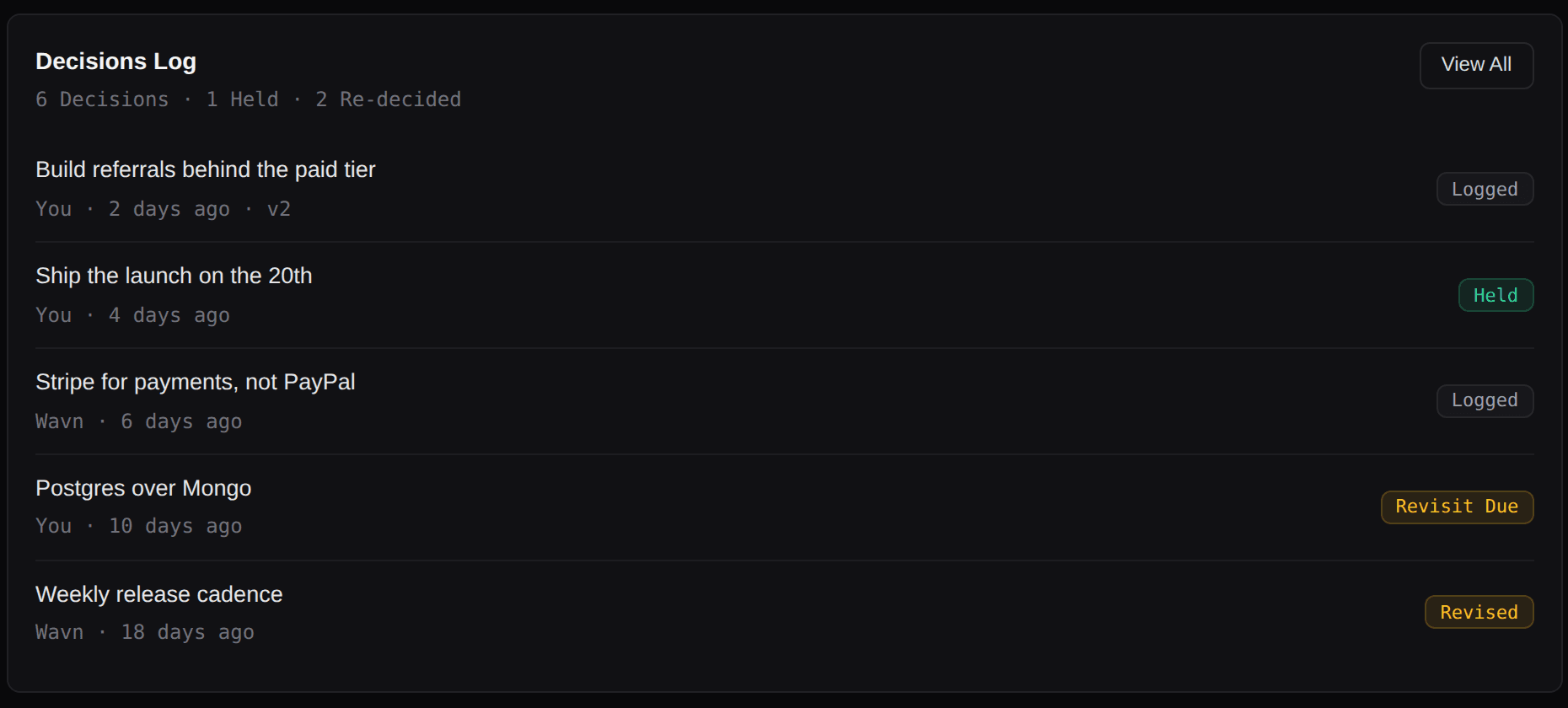
A project’s decisions log: who called it, when, and where it stands. Real screen, example data.
You never pick a model. Wavn does, and switches when it has to.
Most AI products are one company’s model in a wrapper. When that provider has a bad hour, so do you.
Wavn runs on several engines. Its own code assigns each job to the engine that suits it, never the model choosing its own work, and every job has a fallback standing behind it. If the engine on the job keeps stumbling, the next one takes over, and a third is held back for the work that has to be delivered.
You never choose an engine and you never see the handover. You see the work arrive.
Decisions die in scrolls.
Every tool can answer now. Every tool can make a file. That was never the hard part.
The hard part is the call itself. Weighing two options that both look reasonable. Committing. Then, months later, defending it, when the person who objected has left and the conversation it happened in is forty screens up in a chat that no longer exists.
Where the call gets made, and stays made.
You weigh the call with Wavn in plain words. When you commit, one tap locks it as a decision: what was decided, why, and when to look at it again. From that moment it is memory, not a message.
When a conversation actually settles something, Wavn says what it heard and asks whether to record it. You can always say it is not a decision. It proposes; you decide, and nothing reaches the record without your hand.
A call worth revisiting carries a date, and on that date it returns to be checked: still right, or re-decided with the old reasoning in front of you. Nothing rests on anyone’s memory.
Every locked call in one place: what was decided, what was contested, what is still open, who objected and why. Point at it in the meeting. Hand it to whoever asks in a year.
One confident answer is easy. Wavn makes you keep the reasons.
Every tool will hand you a single confident answer, and a single confident answer is the most dangerous thing an AI can give you. Wavn makes the answer show its work - what it is sure of, what your own material does not support, what stayed open - and then you make the call, and it is kept.
That is why a decision made in Wavn survives the meeting, the quarter, and the person who asks why.
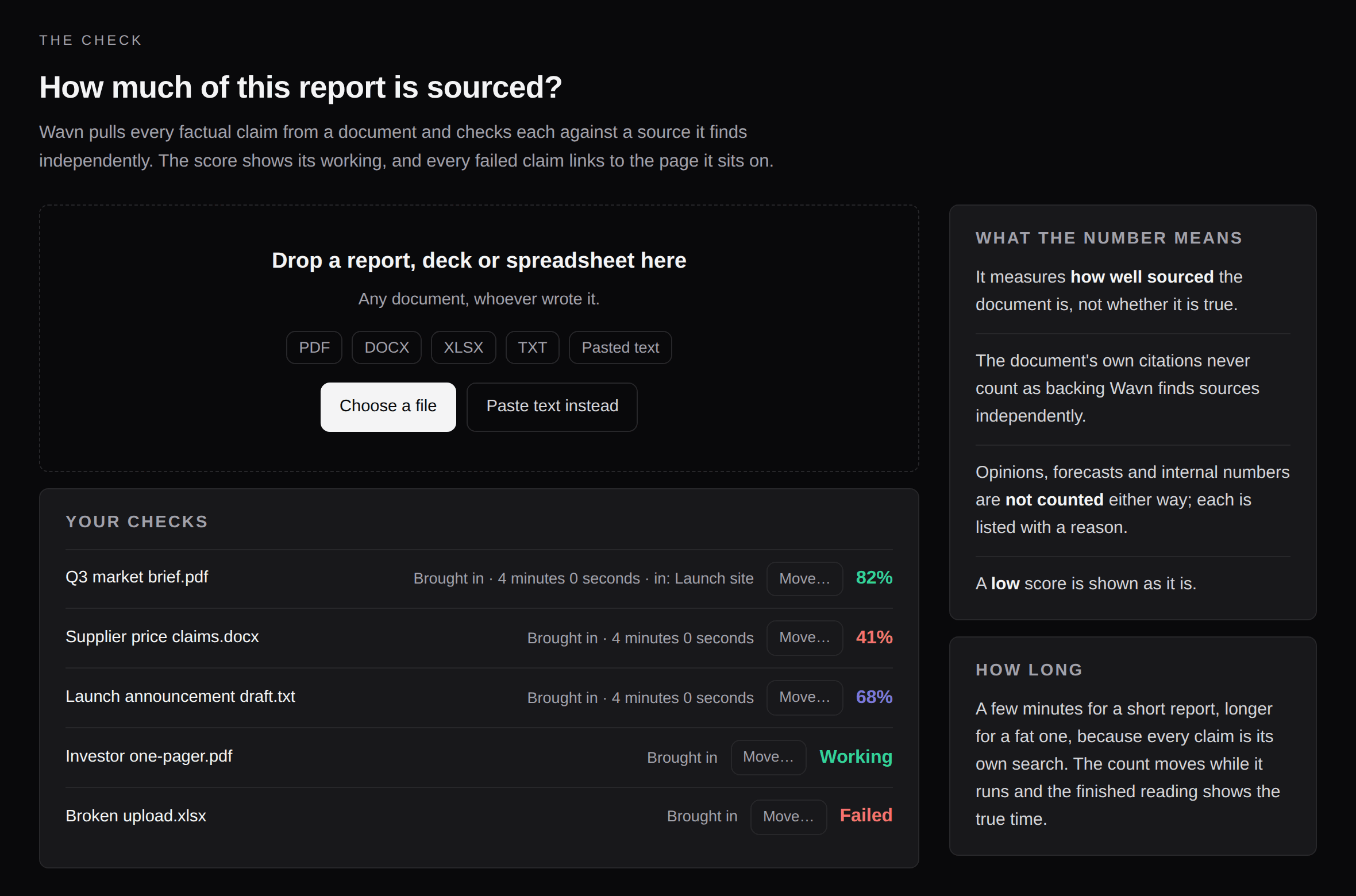
The check: every factual claim verified against a source Wavn finds itself. Real screen, example data.
Other tools stop at the answer. Wavn carries the call through.
From the first “should we?” to the day someone asks “why did we?” Wavn is beside the decision the whole way: it talks it through with you, offers you the call when the conversation settles one, holds the history, and brings it back when it is time to check it was right. Months later you ask about any of it and Wavn answers from what actually happened, not from what anyone remembers.
And yes, the work the decision demands, the sheet, the letter, the deck, arrives finished along the way. Every AI can make a file. We treat that as table stakes, and spend our ambition on the part none of them have: everything after the answer.
Watch one real call go through. Then bring yours.
Free to start. The argument, the lock and the record are never metered.